- Home
- article
- Family Offices and Startups: From Capital Providers to Long-Term Partners
Family Offices and Startups: From Capital Providers to Long-Term Partners
As India’s startup ecosystem matures, family offices are stepping beyond their traditional role of wealth custodians. A panel of founders, operators, and investors discussed how family offices are evolving into patient, strategic partners for startups bringing capital, context, and long-term engagement that increasingly complements venture capital.
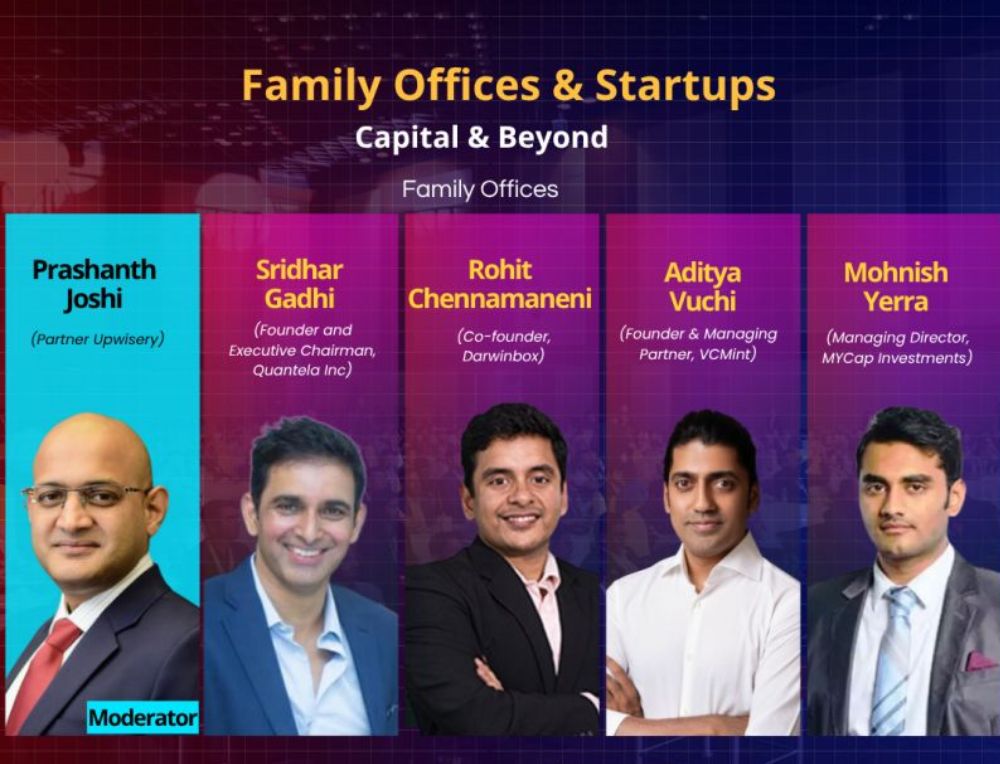
Family offices in India are undergoing a quiet but significant transformation. Once known primarily for conservative capital preservation, they are now emerging as active participants in the startup ecosystem deploying risk capital, offering strategic access, and engaging with founders beyond the cheque. This shift was explored in depth during a panel discussion titled “Family Offices and Startups: Capital & Beyond,” moderated by Prashanth Joshi, Partner at Upwisery.
Setting the context, Joshi defined family offices as professionally managed investment structures created by families with liquidity to invest across asset classes such as equity, debt, startups, IPOs, pre-IPOs, and real estate. While startups are now widely understood, he noted that family offices have traditionally focused on wealth preservation. That approach, however, has evolved significantly over the past decade as family offices globally and in India have begun allocating serious capital to startups.
The panel brought together four distinct perspectives: Mohnish Yerra, Managing Director at MYCap Investments, representing a second-generation, process-driven family office; Aditya Vuchi, Founder and Managing Partner at VCMint, a former founder turned investor; Rohit Chennamaneni, Co-founder of Darwinbox, who invests alongside running a high-growth company; and Sridhar Gadhi, Founder and Executive Chairman of Quantela Inc., a technologist and long-time strategic investor.
An Evolving Relationship
Addressing how the relationship between startups and family offices has evolved in terms of deal size, quality, and engagement, Mohnish Yerra highlighted diversification as a key driver. When he began building the family office, he observed that most networks were tightly aligned to the core family business. Startups, despite their higher risk, offered a meaningful diversification opportunity.
“The number of family offices in India has grown 5x to 6x in the last 7–8 years,” Yerra said, adding that with the right allocation of risk capital, startup investments can significantly enhance a family office’s overall portfolio.
Aditya Vuchi reflected on his own liquidity event after selling a company to a private equity firm. While conventional advice urged caution, his entrepreneurial instincts led him in a different direction. He chose to allocate 10–15% of the capital pool to early-stage startups, while keeping the remaining 85% aligned with traditional family office investments. “We built teams with two different mindsets,” he said, noting that early-stage investments are made in a founder-friendly manner, writing cheques of $100,000 to $200,000.
Rohit Chennamaneni spoke from experience as a founder who raised capital from family offices during Darwinbox’s international expansion. In Southeast Asia, he said, family offices offered a distinct advantage. Rather than brand-name capital, what mattered was local understanding and access. Small cheques from regional family offices helped navigate markets like the Philippines, Indonesia, and Thailand.
Sridhar Gadhi traced the shift to generational change. Earlier, investments were largely limited to real estate, listed equity, or pre-IPO opportunities. Over the last five years, however, next-generation family members—often trained in private equity or investment banking have returned to India to set up professional family offices. As technology and industry converge, he noted, family offices are being pushed closer to innovation.
Beyond the Cheque
A central theme of the discussion was the value family offices bring beyond capital and how that differs from venture capital. Gadhi pointed out that, unlike VCs, family offices are not bound by rigid fund cycles. “If a company is performing well, we can stay invested longer,” he said, emphasising patient capital.
Yerra added that family offices can be flexible on valuations and bring deep relationship capital. “It’s not just capital meeting the founder; it’s connections meeting innovation,” he said, referring to faster access to customers, partners, and validation.
Vuchi highlighted the importance of founder-led capital. He observed that many founders seek investors who understand the emotional and operational realities of building a company. “Founders on the cap table add a very different kind of value,” he said.
Chennamaneni agreed, noting that family offices manage their own capital rather than that of others. This, he said, creates entrepreneurial empathy and a deeper understanding of real business constraints, speed, and risk.
Competing or Complementing VCs
Regarding whether family offices and venture capital funds compete for the same deals, the panel largely viewed the relationship as complementary. Vuchi pointed to a funding gap in the $100,000–$300,000 range, where family offices are particularly well positioned. He described an ecosystem where early-stage funds, family offices, and larger VCs collaborate and share deal flow.
Yerra echoed this view, noting that despite valuation challenges in sectors like edtech, collaboration between angels, VCs, and family offices remains strong. Out of MYCap’s 28 investments, he shared that the portfolio has already seen five exits and two partial exits.
Strategic Collaboration with Funds
Both Gadhi and Chennamaneni described active collaboration with venture funds. Gadhi noted that funds often bring him promising companies that are not yet VC-ready, inviting him to step in early. If the company performs, funds are willing to participate later. He also cited acquisitions in which funds sought out operators who could manage and integrate businesses.
Chennamaneni shared similar experiences, saying institutional investors often approach him because of Darwinbox’s operational track record. In such cases, investors see value in having experienced operators join early rounds to support founders.
When asked whether he would choose a VC or a family office if given equal access, Chennamaneni said the answer depends entirely on geography and stage. In Southeast Asia, a phone call from a well-connected family office mattered more than brand-name VC backing, while in markets like the US, VC brand value could be more impactful.
Investment Philosophies
The panellists’ investment theses reflected their diverse backgrounds. Yerra outlined a structured allocation strategy with 20% allocated to startups and a detailed evaluation framework based on manpower, methodology, market access, mentorship, and funding.
Vuchi described early-stage investing as deeply personal, shaped by his own founder journey. For him, the 15% allocated to startups is driven as much by belief in founders and vision as by financial metrics. Chennamaneni emphasised that at the early stage, his decisions are “80% founder and 20% everything else,” relying heavily on execution ability, articulation, and trust.
Gadhi said his investments are primarily strategic made where he understands the business and can actively help. Founder quality and trusted co-investors, he said, play a decisive role.
Engagement, Expectations, and Governance
On engagement depth, panellists acknowledged practical limits. Vuchi said he remains closely involved with 5 to 7 companies at a time, while Chennamaneni is upfront with founders about his limited availability. Yerra stressed that value is best added when founders are open to support, and Gadhi highlighted time constraints unless the investment is strategic.
Post-investment expectations centred on communication and trust. Vuchi looks for simple, regular updates; Yerra emphasised clarity, reporting, and leadership integrity; Chennamaneni said honesty is the only non-negotiable; and Gadhi pointed to culture as the ultimate indicator of a company’s health.
As the session concluded, the discussion underscored a clear shift: family offices are no longer just capital providers. They are becoming long-term partners bringing patience, perspective, and participation to India’s startup journey.